Browse Category

Finance

An Unexpected Economic Computation

Here’s a calculation that I found pretty surprising. Have a guess as to its meaning:

 \dfrac{\left( \dfrac{60}{(24-15)} \times 2.40 \right)}{1 - (0.4 + 0.02)} \approx 27.59

If you guessed something relating to savings, you’d be on the right track; the denominator would probably have clued you in to something along those lines, since the 0.4 + 0.02 is the marginal tax that higher rate earners in the UK would face (as of the 2016/17 tax year). You might have figured out then, that the fraction on top probably refers to some form of a time savings expressed in minutes. The 2.40 is probably a bit more puzzling especially if you’re not from London; from the previous observations it’s the cost of taking some convenience that saves nine minutes. That’s right; you might recognise that as the price of a single-trip Tube fare.

Putting that together, that computation is actually the effective hourly gross rate I’m being paid to walk to my office as opposed to taking the Tube. Specifically, I’m comparing (a) taking the Tube, which takes about 15 minutes plus a single trip fare of 2.40, and (b) walking, which takes 24 minutes. We’re thus looking at a net rate of 2.40/9 minutes. Of course, I pay for the Tube using post tax money, so we need to factor that in, and to get an hourly rate we scale that linearly.

Now of course this doesn’t mean I’ll never take the Tube to work again, or even that I’ll take it much less often – the 9 minute difference can be important (say there’s a high priority issue going on, or I’m about to be late for a meeting), and walking can be pretty unpleasant (if I’m very tired, it’s late, or it’s too cold; that said, I’ve done this in the current ~0 degree weather and found it fine, at least). Probably, doing this in the mornings would generally be more reasonable and sustainable as I’m pretty tired by the end of the day. Saving one trip even occasionally is enough of a win, I’d say, and getting some time to clear my head in the mornings is probably not too bad as well.

A question could be why I don’t use a Travelcard for the computations instead. The weekly one for zones 1-2 costs 33 and since I largely stay within zone 1 and 2 we can assume that that’s all I’ll need (I’ll ignore the odd trip to Heathrow). I think 16 or 17 is probably about the number of rides I’d take in a week if I used it aggressively (two a day, maybe three or four on the weekends). We can re-run the numbers with \frac{33}{16.5}, which means a trip costs 2.00. Our final answer is 22.99 which is still pretty solid (if you work 42 hours a week that’s a gross annual income of just over 50,000). Anyway, as it turns out because I use contactless, if I happen to have a week where I do travel a lot I’ll effectively be using one.

Now let’s have a look at the monthly or annual tickets. These cost 126.80 for monthly, or 1,320 for annual. Assuming that we make 2.357 trips a day on average (taking the middle of the estimates above), and a month as 365.25/12 days, with the monthly card the cost of a trip falls to 1.767 and with the annual card it falls to 1.533. The “gross wage” calculations become 20.31 and 17.62, which while not as high are still solid amounts. 17.62 an hour corresponds to about just over 38,000 in gross income assuming a 42 hour week, which would put you in about the 78th percentile of earners according to the ONS data for 2013-2014. I guess this will probably be a bit lower now, with inflation/wage growth, but still decent.

Assuming usage is high, it seems that the annual card might be the way to go. However, an issue is that I sometimes need to travel overseas for work potentially a fair chunk (let’s say personal plus work travel adds up to two months a year), so the annual one is quite definitely a non-starter. Multiply the price of a trip by 6/5 to factor that in, and you end up with a per-trip figure that’s higher than the monthly card. I have been getting the monthly card in the past, especially when I was a student and it only cost 86.50, partly because walking to Imperial was going to take a very long time (that route yields savings more on the order of 30 minutes). Note that while losing a card is a legitimate concern, you can usually recover the travel passes using the TfL website.

(N.B. This idea was conceived independent of the currently ongoing Tube strike, though in a sense it’s a bit of a bonus that things aren’t affected.)

Navigating Tube Fares

A bit of an additional post for the week, as I’ve had a little bit more spare time! This post is a more fully-fleshed out response to a question my friend Andrea had, about the value of an annual travelcard.

I’ve started doing my preliminary accounts for 2016, and one of the things I examined was my transport expenditure. I typically try to use what’s known as zero-based budgeting (that is, each category and the value assigned to it is justified from fresh assumptions, rather than say raising the previous year’s data by RPI and calling it a day). Of course there’s some flexibility (I’m not going to pass up a social gathering just because of finances, unless it’s insanely expensive – which is unlikely given the background of my friends, or at least the activities we take part in together).

There’s a column of 86.50s, corresponding to a string of monthly zone 1-2 Travelcards purchased on student discount. We then have a crash to two low months as I was in the US and Singapore respectively, a figure just over 100 for November, and December looks to be closing around 50; I didn’t purchase any Travelcards after August. At the time, I made these decisions because I was unsure if going for the annual Travelcard was a reasonable idea, especially given that I would frequently not be in London owing to international travels, both for work and for personal affairs. The total cost for the category for the year was 894.68; this is lower than normal because I didn’t purchase any flights this year. I’ve been a bit cautious having been deployed internationally on quite a few occasions; I didn’t realise that you can refund the remaining value of a Travelcard!

This would have been 924 if I bought an annual zone 1-2 Travelcard (sadly, I’d now need 1,320 as I’m no longer a student); that said, with one I might have travelled more as well. Also, I was out for two months and started occasionally walking to the office in December. You can get refunds on the remaining value of a Travelcard – that said, I’m not sure repeatedly canceling and then repurchasing annual Travelcards is permissible, and it seems like it would certainly be inconvenient. Loss shouldn’t be too major of a concern, as Oyster cards can be registered to an online account which one can use to transfer a season pass away from a lost card. (I’ve done this before, though with a monthly pass.)

I think a question would then be as follows: exactly how frequently (in terms of number of days) do I need to use the Tube to make pay-as-you-go (PAYG)/monthly/annual Travelcards the best choice? We can examine that under a few assumptions:

  • The traveller is an adult.
  • All journeys are within Zone 1.
  • PAYG is implemented through contactless, so weekly caps apply.
  • The year begins on a Monday (this matters for weekly capping computations).
  • 16/7 trips per day (that’s reasonably realistic for me).
  • (Somewhat cheeky) If one travels for N days one travels for the first N days of the year.
  • Journeys on day are made between 0430 of D and 0430 of day D + 1.
  • The “greedy monthly flexible” (GMF) strategy works as follows:
    • It buys monthly travelcards as long as there are full months remaining.
    • For the partial month (if one exists), it uses the cheaper of:
      • a monthly travelcard
      • PAYG (with weekly capping)

Obviously GMF dominates a pure PAYG strategy, because for full months a monthly travelcard always beats PAYG (consider February), and for partial months GMF considers PAYG, so it does at least as well as PAYG. If I’m not wrong GMF is optimal under these contrived conditions: it intuitively seems difficult to recover from burning through February, the shortest month, without buying the monthly travelcard as you’d need four weekly ones. However, in the general case GMF is certainly not optimal (consider the period February 28 – March 31; you can buy the Travelcard on February 28, which expires March 27, and then pay for four days of fares, or pay February 28 and buy the Travelcard on March 1; the optimal strategy saves three days of fares).

The fare if one has to travel for N days is reflected in the graph below; and unsurprisingly the flexible methods are superior for small N but inferior for large N. Our model has a break-even point at about 314-315 days.

The final decision, unsurprisingly, boils down to the level of certainty you can have about your travels. If you don’t expect to be spending more than around 50 days outside of the UK, the annual travelcard seems like an idea worthy of consideration especially if you know when said days lie. That said, we have made two key assumptions, one of which favours the monthly strategy and one of which favours the annual one:

  • An upfront lump-sum payment is needed if you’re using the annual scheme. Our analysis did not account for the time value of money (you would need to discount the monthly payments to today to get a fairer comparison of the two).
  • However with the monthly strategy we’ve assumed that plans are known well in advance (at least a month) and implementation is done perfectly. In practice, there are likely to be some minor errors or plans not aligning neatly on month boundaries that will result in slightly higher fares.

I personally don’t expect to travel more than that, but I won’t be getting an annual card next year, for other reasons. (In particular, that “16/7 trips per day” assumption is unlikely to be valid, but that’s a subject for another post.)

Interest on the Interest

midpoints

I don’t remember the early years of my education that well. I do remember that maths was consistently my favourite subject back in primary school, though I wasn’t particularly good at it.

Anyway, it was around year 4 (so I was about 10 years old) when I started to take a bit more interest in personal finance. I’m not sure why this happened (I don’t remember young Jeremy being very interested in material things, and although the dot-com crash was in 2001 I’m not sure I knew about it at all back then!). I think at the time I viewed the stock market as very speculative (clearly hadn’t heard of mutual funds or ETFs); the childish me probably saw it as an “adult thing” to do as well (to be fair, if manually picking stocks that’s probably a reasonable view). I was thus more focused on what the older me would recognise as fixed-income investments.

However, in any case, I had saved some money from birthdays and the Lunar New Year, and given that I wasn’t going to be using it immediately I thought it would be good to put it to work. I was vaguely aware of how banks worked, at least as far as retail banking was concerned (i.e. the bank takes your deposit at rate x and lends out your money at y > x; the delta is for the service of matching depositors and borrowers). I was also aware of other schemes such as fixed deposits and other types of savings accounts. Interest rates at the time were about 2 to 3 percent, and knowing little else I thought that was not too bad for a start; my account at the time had an annual equivalent rate of 3%.

I remember looking through my bank statements then, and noticing that interest was paid twice a year, at the end of June and December. It didn’t take long for me to figure out that the December figure was bigger, at least partially because it was calculated including the interest from June. I then started wondering what would happen if the interest payments were made monthly, daily … or even billions of times per second. With some research I learned about continuous compounding; even if you were able to do this compounding at 3% infinitely often you’d still “only” get a rate of e^{0.03} - 1 = 0.0305 for your efforts.

However, the figures didn’t tally up with my calculations for a long while. I remember initially wondering why I wasn’t paid exactly 1.5% on each payment. Nevertheless, by then I had some familiarity with exponents, and I realised that 1.015^2 = 1.030025 > 1.03 and really we should be expecting \sqrt{1.03} - 1 = 0.01489 each time, rather than 1.5 percent. Still, this didn’t square up with the figures (it was getting down to cents, but still). I let the matter rest at the time, since it was broadly correct. Also, I noticed that the June payments tended to be a little small, the December payments a little too big – so I thought it averaged out in the end (which it did – that’s the point of an AER!).

Anyway, 15 years later I found the reason why, as part of prep work for a reading group I’m doing with Stan. I’m surprised I didn’t think about it back then especially given the observation about June and December payments (at the time, I made the oversimplifying abstraction that the payments were made “every six months”). The key is that the interest was calculated using what is known as an act/365 daycount which factors in the actual number of days for the period you were earning interest, and the first “half” of the year is shorter than the second “half”! Consider that in a non-leap year:

  • From 1 January to 30 June you have 3 \times 31 + 2 \times 30 + 28 = 181 days, but
  • From 1 July to 31 December you have 365 - 181 = 184 days!

With this, we can calculate how much should actually be paid each time. We need to solve

 \dfrac{181}{365} r + \dfrac{184}{365} r \left( 1 + \dfrac{181}{365} r \right) = 0.03 \leadsto r \approx 0.0297783

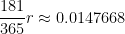
And so for the January-June period, on a $1 investment you would expect interest of

 \dfrac{181}{365} r \approx 0.0147668

which is notably less than the 0.01489 figure that we have treating each month to be the same length.

Note that a wide variety of daycount conventions are used, depending on which financial instruments are concerned! There is the 30/360 daycount, where every month is treated as 30 days and the year as having 360 days, which makes month-level abstractions valid but becomes unpleasant when you go below that; you also have the act/360 which like act/365 seems computationally nice. There’s also act/act (used for US treasury debt, notably), which guarantees identical value per day within a period at the expense of dealing annoyingly with leap years and/or the fact that the number of days in a year is odd, and many further variants of what I’ve discussed so far as well including a few particularly nasty ones that scale on business days as opposed to calendar days.

  • 1
  • 2